Trans-Cranial Magnetic Stimulation (TMS)
A Possible & Needed Treatment Option for "Treatment Resistant" Mental Illness
ORCHID NOTE: TMS is probably NOT a one-stop perfect mental health treatment. On the other hand, it is important that as a Society we can honestly deal with the complicated profiles of psychiatric medications and acknowledge the need to provide other options.
Further, according to the National Institute of Mental Health (NIMH) it seems that many "mental illnesses" are much more BLURRED than "distinct" illnesses. NIMH has identified common calcium channel problems among the BIG 5: Autism, ADHD, Bipolar Disorder, Depression & Schizophrenia (see Blurred Lines).
Very interesting are findings that DRUG RESISTANT Mental Illness may be a prime candidate for TMS, and vice versa Drug Amenable Mental Illness may not be a good candidate for TMS.
MIT Brain/Mind Summit
Dr. Amit Etkin: References Studies Re: Who Might Benefit from TMS
(traditional treatment resistant candidates may be good candidates for TMS)
Amit Etkin, MD, PhD is an Associate Professor in the Department of Psychiatry and Behavioral Sciences at Stanford, a member of the Stanford Neurosciences Institute, and an Investigator at the Palo Alto VA.
e has received multiple awards, most notably the NIH Director’s Pioneer Award in 2017, for groundbreaking work in clinical psychiatry and neuroscience. Dr. Etkin is trained as both as a neuroscientist and psychiatrist, having received his MD/PhD under the mentorship of a Nobel Laureate.
The overarching aim of the Etkin lab is to understand the neural basis of emotional disorders and their treatment, and to leverage this knowledge to better understand how the brain works and to develop novel treatment interventions. In support of this goal, Dr. Etkin also collaborates with neuroscientists, engineers, psychologists, physicians and others to establish a new intellectual, scientific and clinical paradigm for understanding and manipulating human brain circuits in healthy individuals and for treating psychiatric diseases including depression, anxiety and post-traumatic stress disorder.
Building on his Pioneer Award-recognized research, he is presently developing a true “Brain Vitals” approach for assessing the brains of patients over time, engineering new and more powerful methods for non-invasive brain stimulation, and establishing predictive neuro-signals for understanding who responds to what treatment in psychiatry.
Dr. Etkin collaborates with investigators across multiple continents on these efforts and is committed to scaling his neuroscience insights from the lab into clinics worldwide.
He also engages heavily within an academic-industry ecosystem aimed at transforming the diagnosis and treatment of post-traumatic stress disorder.
e has received multiple awards, most notably the NIH Director’s Pioneer Award in 2017, for groundbreaking work in clinical psychiatry and neuroscience. Dr. Etkin is trained as both as a neuroscientist and psychiatrist, having received his MD/PhD under the mentorship of a Nobel Laureate.
The overarching aim of the Etkin lab is to understand the neural basis of emotional disorders and their treatment, and to leverage this knowledge to better understand how the brain works and to develop novel treatment interventions. In support of this goal, Dr. Etkin also collaborates with neuroscientists, engineers, psychologists, physicians and others to establish a new intellectual, scientific and clinical paradigm for understanding and manipulating human brain circuits in healthy individuals and for treating psychiatric diseases including depression, anxiety and post-traumatic stress disorder.
Building on his Pioneer Award-recognized research, he is presently developing a true “Brain Vitals” approach for assessing the brains of patients over time, engineering new and more powerful methods for non-invasive brain stimulation, and establishing predictive neuro-signals for understanding who responds to what treatment in psychiatry.
Dr. Etkin collaborates with investigators across multiple continents on these efforts and is committed to scaling his neuroscience insights from the lab into clinics worldwide.
He also engages heavily within an academic-industry ecosystem aimed at transforming the diagnosis and treatment of post-traumatic stress disorder.
TMS on Pubmed: Regarding "Treatment-Resistant" ("Mental Illness")
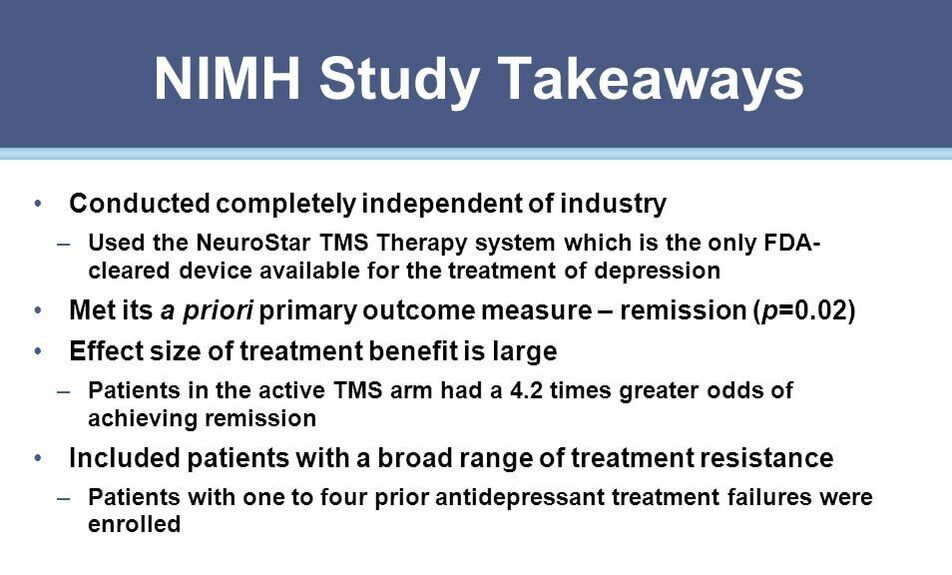
Beyond Pills: When the Most Common Depression Therapies Don't Work (2010), Brown University, Industry Representative, & Depression Advocate ----Slide 36
|
|
"Brain stimulation therapies are important and effective treatments for people with depression and other mental disorders.
"The National Institute of Mental Health (NIMH) is supporting studies exploring how to make brain stimulation therapies more personalized and effective while reducing side effects. "Dr. Sarah Lisanby, Director of the NIMH Noninvasive Neuromodulation Unit, and Dr. Matthew Rudorfer, Associate Director of the NIMH Treatment Research Division of Services and Intervention Research, describe transcranial magnetic stimulation and electroconvulsive therapy for treatment-resistant depression." See: www.nimh.nih.gov/braintherapies. |
The BIG 5 & PTSD
ADHD & TMS |
AUTISM & TMS
|
BIPOLAR DISORDER & TMS |
DEPRESSION & TMS |
SCHIZOPHRENIA & TMS |
PTSD & TMS |